IC PARTS HUB

02

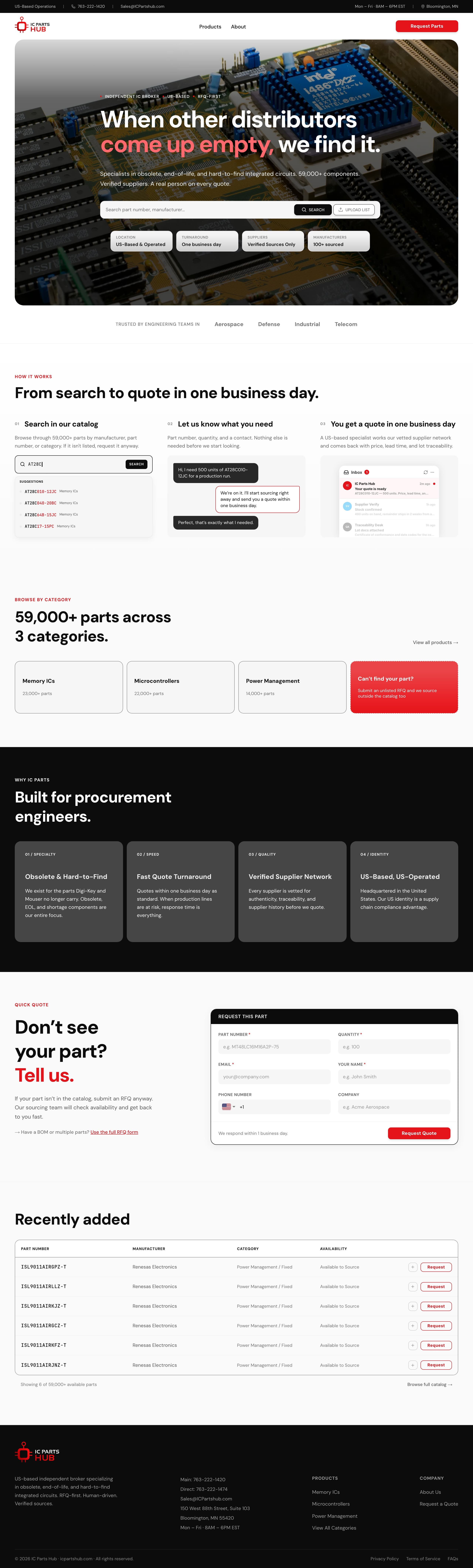
IC Parts Hub helps procurement engineers source the obsolete, end-of-life, and hard-to-find integrated circuits they can't get through authorized distributors. I owned the design end to end, from auditing the client's business to scoping the build to QA on the live product.

RoleProduct Designer end to end
Year2026
ClientIC Parts Hub
ProjectB2B sourcing platform
THE PROBLEM

Buyers arrive after the easy options have failed

Buyers have searched an exact part number because Digi-Key or Mouser came up empty, and the alternative is a costly redesign of their own product. They show up expecting what authorized distributors trained them to expect: live pricing, live stock, instant answers.


The work was to make the experience read as the fastest, most credible path to the part, not as a site that's missing half its information.

DISCOVERY & SCOPE

Auditing the business, then scoping the work

The decisions downstream are only as good as the understanding behind them, so I started with the business, not the screens.

  • Discovery. A structured intake with the owner and sales lead pinned down the real buyer (procurement engineers at OEMs and contract manufacturers, on desktop), the RFQ process, and the company's genuine edge: reliable sourcing, short lead times, and named human experts.
  • Competitive audit. Five competitors reviewed across positioning, RFQ flow, trust, and craft. The gaps were the opportunity: weak trust signals across the board, almost no related-parts or comparison tooling, and US-based identity as a live advantage under 2026 tariff pressure.
  • Scope of work. That fed a sitemap, URL scheme, and page-level requirements tied to three business outcomes: discoverability across the catalog, fast quote conversion, and trust through transparency.

Every interface decision that followed traces back to one of those three outcomes.

KEY DECISIONS

Turning a no-price model into a page that converts

  • Reframe the model as a feature. A 3-step Search → Request Quote → We Source It explainer answers "why is there no price?" before it becomes a reason to leave.
  • Designed for paid acquisition. This business runs on Google Ads, so the product page is a paid-traffic landing page first. I designed the PDP as a conversion surface, quote action above the fold, a pre-filled RFQ, and the trust and availability cues a buyer needs before committing, so spend doesn't leak on a slow or ambiguous page.
  • Trust on the surface. Named experts, explicit US-based identity, and industry credentials, placed where a procurement engineer checks before submitting to an unfamiliar vendor.
  • Desktop-first by choice. The buyer is at a workstation, not a phone. I put the effort into the dense desktop experience first rather than splitting it thin across breakpoints.

The collection page, showing the filtering mechanism that narrows a dense catalog down to the parts a buyer needs.

The product page, leading with the RFQ at the top so the buyer's primary action is immediate.

DESIGNING AT SCALE

Making 59,000 parts resolve into one path to a quote

A 59,000-part catalog where every part is its own page, and its own potential entry point, is fundamentally a data problem. The job was to make that volume resolve into a single clear path to a quote, and the catalog is still growing, with the team actively adding parts beyond the current count.

  • Information architecture built around the exact manufacturer part number as the page's H1, matching how buyers actually search, and how the SEO and paid strategy both land them.
  • Dense, filterable category tables for engineers comparing dozens of parts at a glance, not consumer-style cards.
  • Pre-filled RFQ at peak intent, part number and manufacturer carried straight from the product page into the form, dropping the buyer's effort to near zero.
  • Related parts and a multi-select RFQ tray so buyers can bundle several parts into one quote, closing a gap most competitors left open.
STATES & EDGE CASES

A high-trust tool is judged on its non-happy paths

I designed for states, not just screens:

  • Availability states treated consistently, so the buyer always knows where a part stands.
  • A resilient RFQ form, required versus optional fields tuned to capture leads without deterring them, with email and phone validation and an integrated country-code selector.
  • Full interaction states, hover, pressed, focus, and disabled defined across the system, with an accessible keyboard focus treatment.
  • The unglamorous cases, empty and truncated content, click-to-expand for long category text, confirmation flows, and routing so a dead part number never strands a buyer.

I hardened all of it through structured QA on the live build, resolving issues as developer-ready checklists and lifting recurring problems into single global fixes rather than patching screen by screen.

DESIGN SYSTEM

A token-based system built to scale

A token-based system with a library of reusable components, each defined across its full set of states and built to scale across a growing catalog, so 59,000 pages stay consistent and a non-technical client team can extend the site without breaking it.

IC Parts Hub design system component library
IC Parts Hub design tokens and reusable components
BUILD & COLLABORATION

I work design-to-code

I made the front-end and architecture decisions and delivered implementation-ready design, then partnered closely with the development team that built it.

  • The platform decision, server-side rendering so every product page is indexable, was central to the design strategy, since organic and paid traffic both depend on it. I designed for that constraint and worked with the developers through implementation.
  • A non-technical CMS so the client's team can add parts and edit content without a developer.
  • Designed and QA'd against the deployed product across multiple rounds, translating real data models and routing into the UX rather than designing in a vacuum.
WHERE IT LANDED

Now reading real demand

IC Parts Hub shipped with an architecture engineered for discoverability across the full catalog, product pages tuned to convert paid and organic traffic, and a trust layer built for a cautious buyer. My team and I are constantly monitoring data to read real customer behavior and iterate on it.

View Live Site